

One the first Rolex watches I ever purchased (the first being a 1657 white dial Explorer II) after I started making big boy money was a blue dial Rolex Submariner 16613. That watch was an F serial and I bought it in 2004:
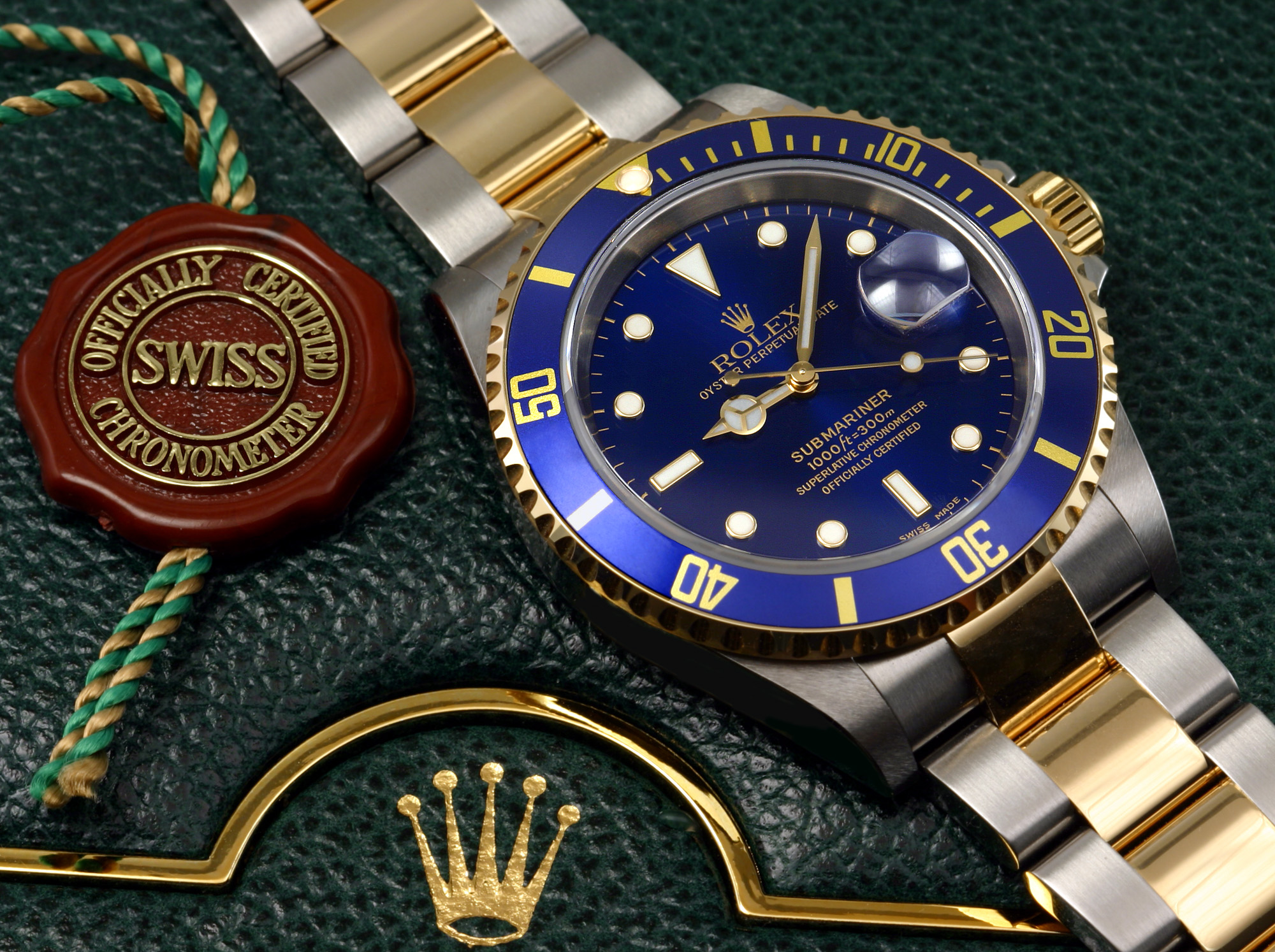
I kept that watch for several years – until the owner of the HVAC company I used offered to trade me even up for the watch against the $10,000.00 heating an air system he installed. Knowing that, at the time, I could replace it for $5000.00, I cheerfully took the watch off my wrist and handed it to him. In truth, I had been wanting to upgrade the watch anyway – somewhere around the D and Z production years, the repeating “RolexRolexRolex” laser engraving on the rehaut (the inner bezel) and I wanted one. It not only looked fantastic, but also made any Rolex that didn’t have the engraving look dated in my eyes. Which of course was silly, but I was young and stupid then (as opposed to being old and stupid now). So within a week of the transaction with my HVAC guy, I had a shinny new Z serial 16613 Submariner on my wrist.

This was during a golden age in the late 2000’s when you could actually walk into a Rolex Authorized dealer and…you know…buy a Rolex <sigh>. Between the two watches, I’ve owned a 16613 Submariner for over 20 years. I actually purchased a 16613 before I purchased the much more ubiquitous 16610 Submariner – because any true watch enthusiast didn’t purchased the 16610 Submariner. That was a watch for the uninitiated. Instead I wore a Rolex Sea-Dweller 16660 – that watch was the choice of the true WIS (watch idiot savant). While many different stainless steel Submariner variants and other Rolex sport watches have come in and out of my collection, the 16613 has endured. It’s been my “ride or die” Rolex.

WHY I’VE KEPT A 16613 FOR OVER TWENTY YEARS
The enduring appeal of this watch for me comes down to two aesthetic characteristics of the watch. First, it was a combination of stainless steel and yellow gold. I grew up in the 1980’s when yellow gold was king. In the history of all things Rolex, the addition of yellow gold was a relatively new addition (the Submariner was after all envisioned as a “tool watch”). It first made an appearance in 1984 in the transitional 16803 Submariner, and debuted as the 16613 Submariner in 1988 – a model that endured until 2009 until it was replaced with the 116613LB/LN. In the nearly 30 years since the 16613 debuted, we’ve seen several trends with regard to gold watches – white gold, pink gold, and rose gold all came and went. Yet yellow gold endured, as has my love for the two-tone Submariner. Yellow gold seems to be enjoying a bit of a resurgence in recent years – some of us never left.
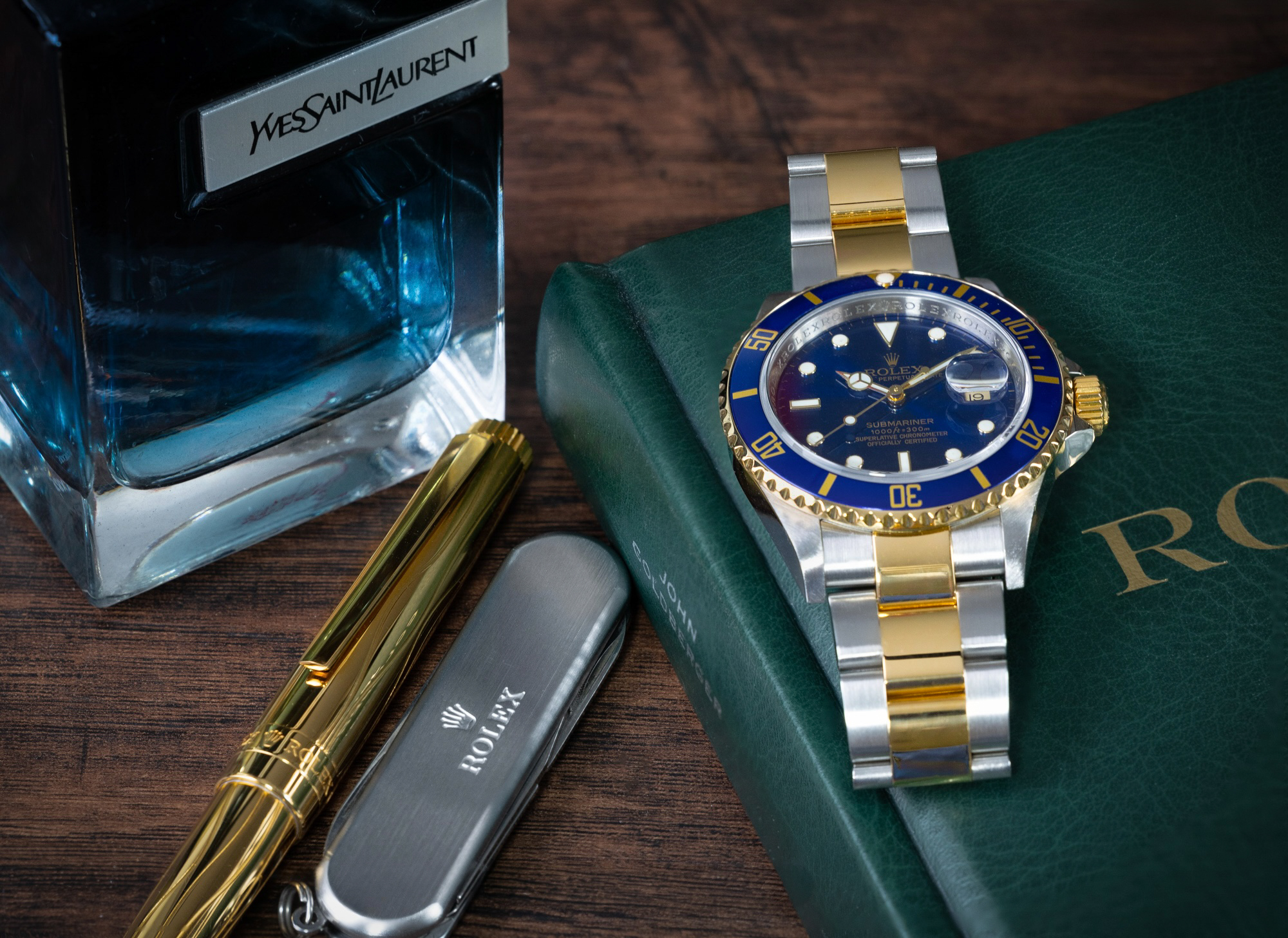
The second characteristic of the 16613 which has kept it in my collection is the gorgeous sunburst blue dial – it’s positively mesmerizing. I consider it to be more of a “royal blue” color but depending on the lighting it can color shift to an almost purple color. The dial well coordinates with the royal blue aluminum bezel of the 16613 – a fact which will become more pertinent later in this discussion. The 16613 is also available in a black dial/bezel variant which I’ve never quite understood. The black dial version certainly isn’t a bad watch. But the blue dial version is a great watch. It’s no contest in my mind.

Together, the blue dial and yellow gold accents create a timepiece that’s hard to ignore – critics call it “over the top” or “tacky.” I disagree. To me, it’s pure luxury. Pure class. Critics also point to the mix of stainless steel and yellow as looking “cheap” or that it screams “I couldn’t afford an all-gold watch.” In my case, I can certainly afford an all-gold watch. But it’s not something that I ever wanted in my working years. A two-tone watch still feels youthful and sporty to me. An all-gold watch has always seemed like something I’d look into when I’m closer to retirement age.
In the years between 1988 and 2009 the Rolex 16613 enjoyed several upgraded features. By 1999, the luminous coating that was applied to the hands and markers had transitioned from Luminova to Super Luminova, improving the dial’s low-light visibility. Solid gold end links and center links were introduced with the 93253 bracelet on the 16613 around 2000. Prior to that, the center links on the 16613 bracelet were hollow and would stretch over time. In the 20 years I’ve owned mine, there is no bracelet stretch. By 2003 the holes which had been traditional drilled into the lugs of the Submariner were eliminated in favor of solid “no holes” lugs. Historically the lugs were drilled to make it easier to stick a tool through the hole and push out the bracelet spring bars making bracelet changes much easier. Since most Rolex owners like myself never remove the incredible Oyster bracelet, it didn’t make much sense to continue to drill a hole into the lugs. Personally I never had a problem with drill lugs on the stainless steel models (which conceivably could still be used for diving) but thought they looked out of place on the 16613 which was far less likely to be the watch of choice for a diver. And as previously mentioned in 2007, the late Z production 16613’s saw the addition of the engraved rehaut. Which means that Z, M, and early V serial production 16613 Submariners were the ultimate expression of the five-digit serial Submariner, until 2009, when it was replaced by the ceramic-bezel 116613LB (blue dial/bezel) and 116613LN (black dial/bezel).
THE MOVEMENT THAT DEFINED THE MODERN SUBMARINER: THE ROLEX CALIBER 3135
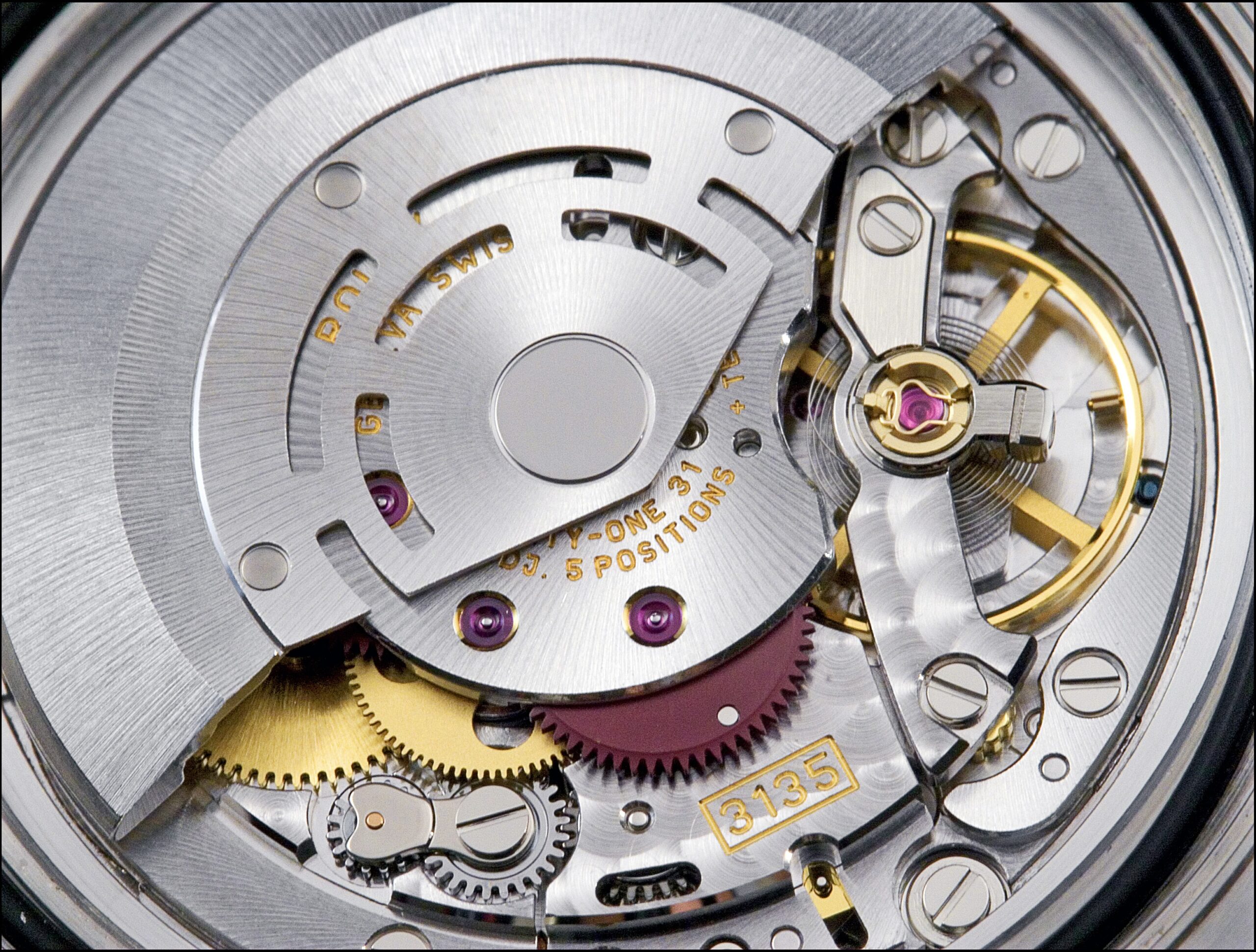
The Rolex caliber 3135 endured not only throughout the 16613 era, but also for the next decade throughout the entire production run of the next generation 116613LB. It wasn’t until 2020 that Rolex replaced the venerable Caliber 3135 with the 3236. That means the Caliber 3135 was used in all versions (with a date display) of the Rolex Submariner for 32 years, making it one of the most successful automatic watch movements ever made. Throughout it’s more than three decades of service in the Rolex catalog, it received several upgrades and enhancements including:
- Better lubricants
- Larger balance bridge
- Parachrom hairspring
- Paraflex shock absorbers
- Better manufacturing tolerances
The Rolex Caliber 3135 is a self-winding mechanical movement with 31 jewels, a traditional Swiss lever escapement, a freely spring Glucydur balance wheel with Microstella regulating screws, and a beat speed of 28,800 beats per hour (BPH). It has a 48 hour power reserve, and historically used a flat Nivarox hairspring, though later in the five-digit serial production run that was replaced with the newer Parachrom Blue hairspring with Breguet overcoil. Throughout the production run the Caliber 3135 was submitted by Rolex for COSC certification (accuracy that could not deviate from a range of -4 to +6 seconds per day) – in doing so, it earned the Rolex designation “Superlative Chronometer.” By 2015, Rolex engineered their own in-house “Superlative Chronometer” testing protocols and standards which exceeded those of COSC. Which by the way many consider a direct response to Omega’s 2014 announcement of the Master Chronometer certication developed with METAS.
THE CLASP – LOVE IT OR HATE IT

Perhaps the most controversial design element of the five digit serial Rolex sport models was the clasp – and the 16613 Submariner was no exception. on the plus side, the design execution of the clasp, gave it a very integrated appearance with the rest of the Oyster bracelet. And no doubt it was a secure clasp. And it even had the cleverly integrated dive suit extension. But the entire clasp was constructed from stamped metal that looked and felt cheap and completely out of place on a watch with both this legacy and price tag. Having experienced the completely redesigned clasp on my 126610 Submariner, I can confidently say that the 16613 clasp is the low point of the watch.

WHY DON’T I OWN A CERAMIC BEZEL MODEL?
Fans of ThruMyLens may know that I sold my 16610 Submariner in 2023 and purchased a 126610LN Submariner. So why haven’t I sold my 16613 and purchased a 126613LB? Well, the first thing you have to understand is, I never like the “super case” era – the more square case look of the 116610LN and the 116610LB. It wasn’t until Rolex came to their senses with the case re-design on the 126610LN that I made the switch. And as much as I like the “Maxi Dial” and Cerachrom bezel on the 126610, I’m not as fond of these features on the two-tone counterpart. The hands and markers look dressy on the 16613 – the Maxi Dial treatment detracts from that in my honest opinion. And I just don’t think that the Cerachrom bezel on the 116613LB and later the 126613LB coordinate as well with the royal blue dials as does the good old aluminum bezel insert on the 16613. So while the watch enthusiast and horological nerd in me geeks out over all the upgrades inside and out of my 216610LN Submariner, I’m quite content to continue wearing my 16613 Submariner, which by the way has continued to steadily rise in value.
There are watches that impress me more on paper. Watches with newer movements, ceramic bezels, longer power reserves, and more advanced materials. Yet none of them surpass the affection I have for the Rolex 16613 Submariner. It’s woven into my identity in a way that connects my youth to the man I’ve become. After more than twenty years, I no longer think of the 16613 as just another watch in my collection. It has become something far greater than the sum of its parts. It’s my past. It’s my legacy—one I hope to pass on to my son someday, even though I’m not entirely convinced he even wears a watch. Until then, I’ll continue enjoying it as perhaps the greatest Rolex Submariner ever made.
Here’s my video review:
0 Comments