

I’ve been looking for a space-saving studio tripod replacement, and this latest generation of one-handed, clutch-operated monopods seemed like a perfect solution. Several of the Chinese manufacturers have product offerings in this category, though SmallRig seems to be out front with their aggressive marketing within the YouTube influencer community. Last week, I reviewed SmallRig 5564 Monopod here on ThruMyLens – it’s probably the lowest-priced offering in this product segment, and I really wasn’t interested in paying $400 plus for some of the more premium offerings. But after trying it out, I decided it was a little bit too lacking in some useful features – so I continued looking for some sort of a middle ground option. Which brought me to the Coman M1 Pro Monopod. It seemed to offer all of the features that I was missing in the SmallRig 5564, and cost less than many competing options. At a retail price of $233, the Coman M1 Pro Monopod was only about $33 more than the retail price on the 5564. Here’s what’s included for the price:

SIMILAR FEATURES…AND COMPONENTS?
Comparing the SmallRig 5564 to the Coman M1 Pro , clearly the two monopods have a similar feature set…partially due to having what appears to be common components. The one-touch adjustment handle appears to be the same on both monopods despite some minor cosmetic differences. Both units also have a rubber grip around their respective carbon fiber tubes – it’s exactly the same component on both.
Here are the specifications of the Coman M1 Pro that demonstrate some key features the SmallRig was missing:
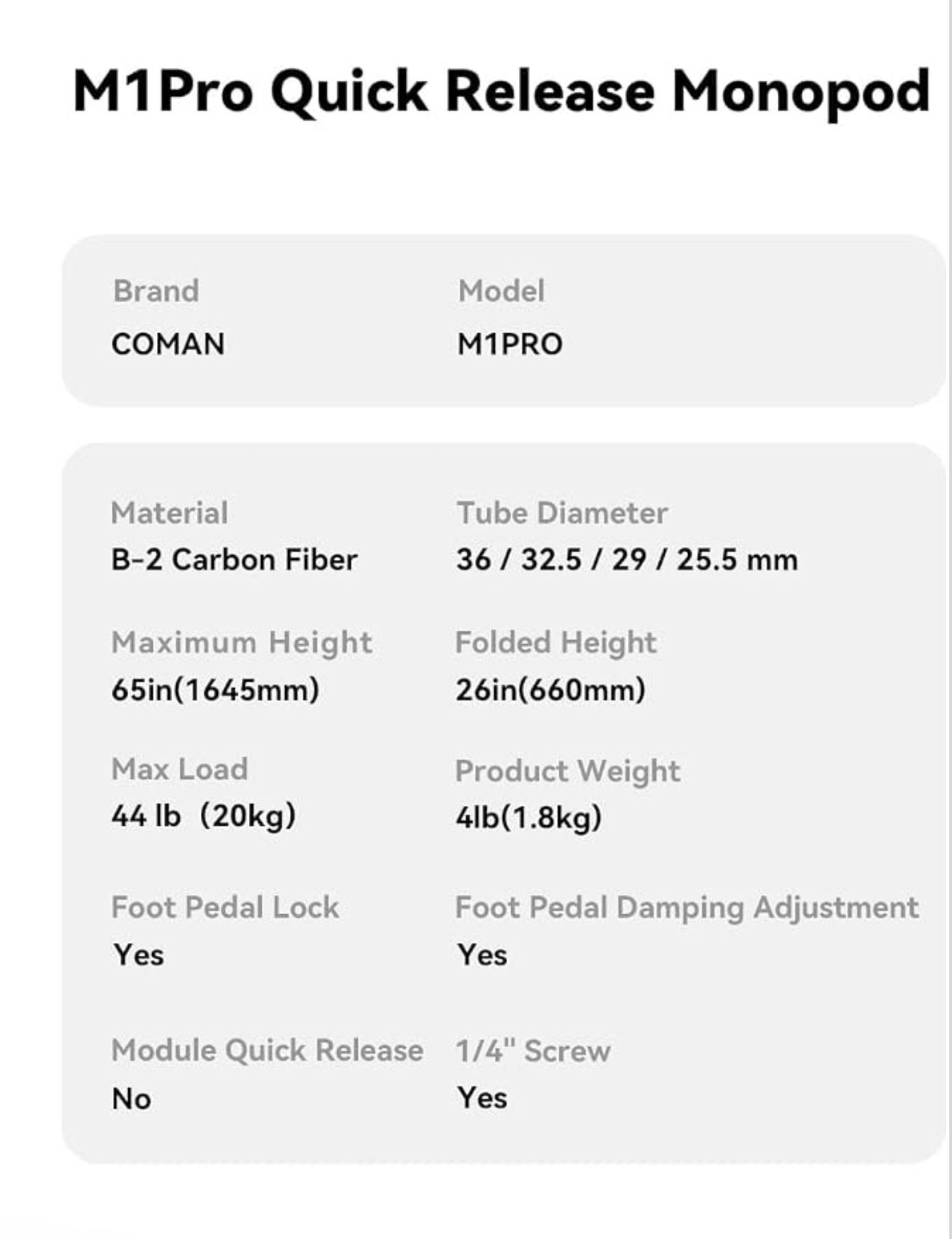
I used the Coman M1 Pro in my home studio for about a week on several projects. I found the operation of the clutch adjustment handle to be exactly what I hoped for, and provided easy and secure camera height adjustment with the small monopod footprint I needed in my tight studio space. While not as stable as a traditional tripod, I had no concerns about leaving the camera mounted on the monopod while I was working around the studio.
WHAT’S “PRO” ABOUT THE M1PRO?
The “non-Pro” variants of the M1 all seem to have a similar cost savings feature set fairly identical to the SmallRig 5564 that I recently reviewed. No foot pedal and no quick release for the monopod components. The Coman M1 Pro adds a foot pedal lock/release that allows the user to manipulate the monopod pole within the three-legged base bowl, then automatically centers it when you lock it back into primary position.

It also enhances the user experience of unscrewing the ball head and monopod pole from the three-legged base by implementing a modular quick-release design. This allows you to quickly and easily place the monopod head directly onto the base to create a “high hat“ tabletop tripod.

Outside of the “pro” feature enhancements, I found the Coman M1 Pro to be largely similar to the SmallRig 5564 in fit, form, and function – all quite good. I couldn’t really find any qualitative difference between the two monopods, and I suspect that would be the case comparing different monopods between several different manufacturers who produce products in this particular segment. Again, there seems to be a lot of use of shared components.

At a maximum height of 65” the Coman M1 Pro extends well above my head, and weighs 4 lbs. That’s about a pound or so heavier than the travel tripods that I tend to use in the field, but for a studio solution the weight is just fine. Using the quick release to remove the monopod pole and head from the base gives you the option of using it as a traditional monopod – and unlike the 5564 I tested, you can remove the rubber stopper from the base and screw it into the bottom of the pole or use the included steel spike that can also be screwed into the bottom:

Like most other products in this segment, the Coman M1 Pro has quarter-inch screw mounts on three sides, so there is no shortage of places to mount accessories. But given the inherently less stable design of a monopod like this over a tripod, the wisdom of attaching a lot of accessories may be questionable.

One of the strategies Coman uses to keep the M1 Pro at a lower price point is to not include a head on the monopod. For my situation, (and I suspect for many other photographers as well), this particular approach is a feature, not a bug. I have <ahem> several other tripods with both photography first ball heads, as well as more video-oriented panning heads. An option in this category that didn’t force me to pay extra for a head that I did not need was greatly appreciated. However, if you don’t have another photo or video head that you can mount on the M1 Pro, you’ll need to factor that into the cost.
I like the Coman M1 Pro – it has the feature set that I was looking for at a price well below competitors in the marketplace with a similar feature set. I like the fact that Coman M1 Pro offers a model that doesn’t force you into a photo or video head that may not be exactly what you’re looking for in order to get the monopod. You have the freedom to choose, which will likely save you some money in the process. So for me, the Coman M1 Pro was the Goldilocks choice in a sea of competing products made in China at a variety of price points. I’ve been very happy with using it as my new studio “tripod.” That’s not to say that it’s the right choice for everyone. But given the robust feature set and the flexibility that it offers at the price point, I think it deserves serious consideration. Here’s the video review:
0 Comments